Empowering Afghans to Participate Meaningfully in an AI-Driven World

We build AI capacity for Afghans through tailored learning programs, institutional cooperation, and access to global learning opportunities, enabling their meaningful participation in an AI-driven world.

What


Founded in 2026 in Hamburg, Germany, AI for Afghanistan (AI4Afghanistan) e.V. builds AI capacity for Afghans through structured AI learning, helping them develop AI knowledge, practical skills, and the ability to apply AI responsibly, strengthening their readiness for a future shaped by artificial intelligence.

How


We work with schools, vocational institutions, universities and other partners to strengthen AI learning pathways for Afghans through training, capacity-building and applied AI practice, connecting them to wider AI learning opportunities through mentoring, AI learning networks, knowledge exchange and applied AI competitions.

Why


AI is transforming our world rapidly, yet opportunities to participate meaningfully in the age of AI remain out of reach for many. In Afghanistan, home to one of the world’s youngest populations, low readiness in AI education makes AI capacity-building essential to help Afghans access structured pathways to responsible AI learning.

Our Programs

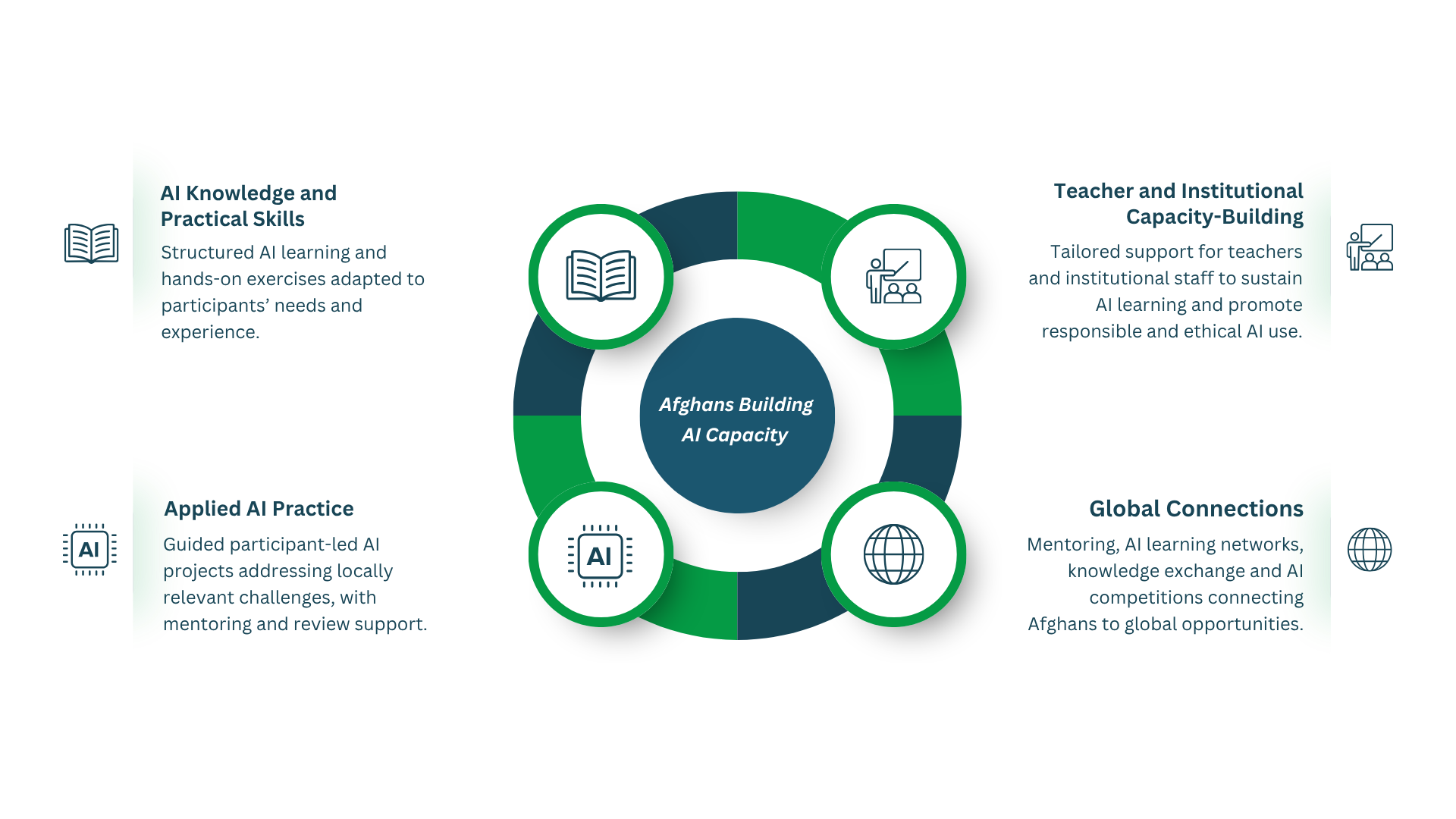
Our two complementary programs bring together AI knowledge and practical skills, responsible and ethical AI, applied AI practice, teacher and institutional capacity-building, and global connections to help Afghans build AI capacity.

Training & Capacity-Building

This program helps Afghan target groups develop AI knowledge, practical skills, and awareness of responsible and ethical AI. Workshops, seminars, and continuing training combine modular learning materials with hands-on exercises adapted to participants’ needs and existing knowledge of AI and digital tools. AI educational resources, open-source tools and e-learning support these activities, while public events, conferences and publications promote public understanding of AI and its responsible and ethical use.
Separately planned initiatives provide teachers with train-the-trainer support, teaching materials and guidance to sustain AI learning within their institutions. Other capacity-building initiatives support Afghan professionals in institutions outside the education sector through AI training tailored to their needs and existing knowledge of AI and digital tools. Mentoring, AI learning networks and knowledge exchange connect participants and institutions to wider expertise and global learning opportunities, supporting progression into applied AI practice and strengthening readiness for further AI learning, employability and locally relevant AI innovation.

Applied AI Projects & Innovation

The program builds on existing AI knowledge and practical skills through guided participant-led AI projects, applied research and pilot activities addressing locally relevant challenges in Afghanistan. Participants receive mentoring and review support as they develop their AI projects, helping them explore AI use cases, test ideas and apply AI responsibly while considering limitations, risks and wider implications. Cooperation with partners supports joint project activities and helps build individual and institutional capacity for future AI innovation in Afghanistan. Project complexity, expected outputs, and the level of support are adapted to participants’ AI knowledge and practical skills, the initiative’s purpose, and available expertise and resources.
Knowledge exchange and relevant AI competitions create opportunities to share project results, engage with international peers and partners, and explore wider themes and project requirements. These connections help participants deepen their applied AI experience and contribute their work and perspectives to broader AI learning and innovation spaces.

Our Focus

We focus on building AI capacity for school students, vocational learners, university students, teachers, professionals, emerging Afghan talent and the interested public, with particular attention to disadvantaged groups in Afghanistan, especially women and girls. Our work brings together AI knowledge and practical skills, responsible and ethical AI, applied AI practice, teacher and institutional capacity-building, and global connections through initiatives adapted to the needs, existing AI knowledge, and capacity of participants and institutions.
AI for Afghanistan (AI4Afghanistan) Four Transformation Components

Delivery Approach

We pursue our long-term goal through a phased, learning-driven delivery approach that moves from preparation and validation to pilot implementation and gradual expansion. We build carefully, test responsibly, and expand based on learning, evidence, and implementation capacity.

Foundational Phase

This phase builds the organizational, operational and programmatic foundations for scoped pilot implementation in Germany and Afghanistan. Key activities include establishing strategic and operational frameworks, building partnerships, engaging expertise from the Afghan diaspora and international partners, and developing AI learning materials, teaching approaches, and delivery formats.
Preparatory learning and validation initiatives for Afghan target groups in either country may include AI knowledge and practical skills development, guided participant-led AI projects, mentorship support, knowledge exchange and applied AI competitions, alongside separately planned teacher and institutional capacity-building initiatives. These activities help us test and refine our Program Model before pilot implementation. Progression depends on organizational readiness, institutional cooperation, implementation capacity, available resources and conditions that make the intended activities feasible and permissible within their applicable geographic scope.

Pilot Phase

When organizational readiness and delivery conditions permit, we begin carefully scoped pilot initiatives in Germany or Afghanistan, according to the applicable geographic scope of the activities concerned. Working with selected target groups, participating institutions and relevant partners, we test our Program Model under real learning and delivery conditions. Pilot initiatives may include structured AI learning and guided participant-led applied AI projects, alongside separately planned teacher and institutional capacity-building initiatives. AI Learning Facilitators support delivery for Afghan target groups within participating institutions. Where infrastructure or learning conditions are insufficient for the planned activities, complementary AI learning spaces may be used for delivery.
Implementation experience, participant and facilitator feedback, and emerging evidence help us refine learning materials, teaching approaches, delivery formats and support arrangements. We assess feasibility, participation, learning progression, institutional engagement and delivery quality to determine whether pilot initiatives should continue, be adapted, paused or considered for gradual expansion. Completing a pilot initiative does not automatically lead to the Scale Phase.

Scale Phase

When pilot evidence and learning provide a sufficient basis, we gradually extend delivery to additional participants, institutions and locations in Germany or Afghanistan. Findings from pilot initiatives guide what we retain, adapt, strengthen or reconsider before expansion. Scaling may involve reaching more participants through AI learning initiatives, providing teacher and institutional capacity-building to additional institutions, strengthening cooperation with existing or new institutional partners, or introducing delivery in additional locations. The scope and pace of expansion are guided by operational capacity, partnerships, available resources and contextual conditions.
Expansion involves adapting delivery to additional target groups, institutions and locations while strengthening capacity for sustained AI learning and responsible AI application. Learning and teaching materials, delivery formats and facilitator support are adapted to participants’ needs, their existing AI knowledge, practical skills, and the facilities available. When sufficient capacity has been built and the necessary resources are available, trained teachers can sustain AI learning, while other institutional staff can apply AI responsibly in their day-to-day work. Expansion remains subject to review and may be slowed, paused, adapted or reconsidered when evidence, delivery quality, available resources or prevailing conditions do not support further expansion.
Long-Term Goal

To build an inclusive and sustainable AI education pipeline for Afghans, enabling them to gain AI knowledge, develop practical skills, and use AI responsibly, strengthening their readiness for further AI learning, employability, and locally relevant AI innovation.

Working Together for Long-Term Impact

We work with schools, vocational institutions, universities, research institutions, organizations engaged in education and development cooperation, and other stakeholders who share our commitment to building AI capacity for Afghans. We also welcome partnerships with organizations and initiatives focused on advancing responsible AI learning, applied AI practice, teacher and institutional capacity-building, and global learning opportunities.
Through institutional cooperation, shared expertise and long-term support, partners strengthen program delivery, teacher and institutional capacity, and participant engagement, creating AI education opportunities for Afghans in both Germany and Afghanistan.

Education & Institutional Partners

Schools & Vocational Institutions

Universities & Research Institutions

Women Who AI (WWAI)

Funding & Support Partners

Supporting Partner

Supporting Partner

Supporting Partner

Be Part of Our Journey

Whether through institutional cooperation, shared expertise, or financial support, every contribution helps open doors for Afghans to build AI knowledge, develop practical skills, and connect to global learning opportunities.